


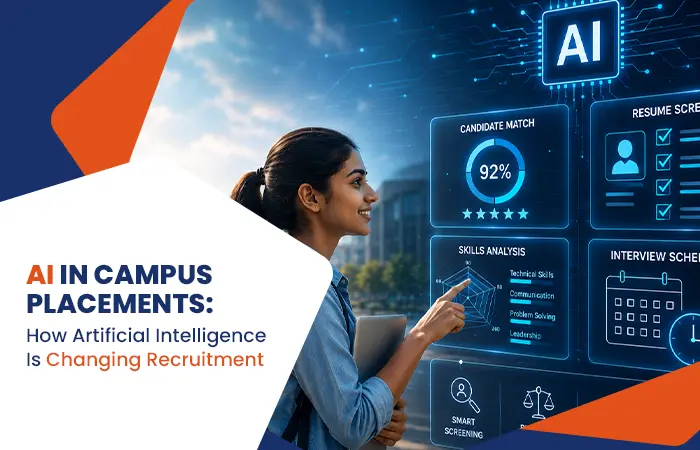
Artificial Intelligence (AI) is transforming campus placements by making recruitment faster, smarter, and more data-driven. Today, companies use AI-powered recruitment tools to screen resumes, assess candidate skills, conduct online interviews, and identify the most suitable applicants before human recruiters become involved. For MBA and PGDM students, understanding how AI is used in recruitment has become essential and students can also explore how AI in Management is transforming business decision-making across industries for improving placement readiness, enhancing employability, and succeeding in an increasingly competitive job market.
What is AI in Campus Placements?
AI in campus placements refers to the use of Artificial Intelligence technologies to automate and improve different stages of the recruitment process. From resume screening and Applicant Tracking Systems (ATS) to AI-powered interviews and skill assessments, organisations use AI to identify qualified candidates more efficiently. Rather than replacing recruiters, AI helps them make faster, more informed hiring decisions while providing a smoother recruitment experience for candidates.
How AI is Changing The Game for Placements
The recruitment landscape has evolved significantly over the past few years. Organisations are increasingly adopting Artificial Intelligence to improve hiring efficiency, reduce manual effort, and identify the right talent faster. For management students preparing for campus placements, understanding AI-driven recruitment processes is no longer optional; it is an important part of career preparation.
Previously, traditional placement models simply consisted of submitting the resume, then manual screening, then group discussion, and the final interview round. Now, an AI-driven placement model works on Semantic Parsing & Skill Profiling, followed by an Asynchronous Video Interview, then comes Gamified Cognitive & Behavioral Testing, and finally a cultural fit interview.
Navigating AI in Campus Placements
To navigate this landscape successfully, students must fundamentally shift their mindset. AI tools are not designed to eliminate human connection or replace the human touch in hiring. Instead, they are deployed to remove administrative bottlenecks, eliminate implicit human bias during early screening stages, and analyze large-scale applicant pools for specific operational competencies.
As a management student, your goal should be to work hand in hand with an AI model so that your resume stands out among the crowd. You should not try to cheat or trick the system but beat it with your skills. You should learn how these automated systems structure and evaluate your profile data. By understanding the parameters of machine-driven evaluations, you can present your academic achievements, internships, and leadership experiences in a format that the system recognizes as elite.
Benefits of AI in Campus Placements
Artificial Intelligence benefits both recruiters and job seekers by making the recruitment process faster, more accurate, and more transparent.
- Faster Resume Screening – AI can analyse thousands of applications within minutes.
- Skill-Based Candidate Matching – Recruiters can identify candidates whose skills closely match job requirements.
- Reduced Hiring Bias – AI helps minimise unconscious bias during the initial screening process.
- Improved Candidate Experience – Automated communication and scheduling make recruitment more efficient.
- Better Hiring Decisions – AI-powered insights help recruiters evaluate candidates more effectively.
Beyond the Resume: How Recruitment Automation Screens Candidates
Campus hiring has become entirely online in the last few years, so automation platforms execute the very first cut among the thousands of resumes and applicants that show interest in a specific job post.
1. Semantic Capabilities Over Keyword Stuffing
Older generations of Applicant Tracking Systems (ATS) relied heavily on literal keyword matching. If a job description required “financial modeling” and your resume listed “financial valuation,” the system might miss the connection.
Modern AI screening tools use Natural Language Processing (NLP) and semantic search. These systems understand context, synonyms, and the structural relationship between your skills. They look at your entire career trajectory, the scope of your live projects, and the complexity of your internships to gauge your true capability, rendering simple “keyword stuffing” obsolete.
2. Predictive Performance Modeling
Hiring tools do not just scan what you have achieved, but they predict what you will do with the set of skills that you already have and the experience that you have collected over the years. These AI tools also compare your profile, including your academic focus, extra-curricular leadership positions, certification paths, and project outcomes, against the historical data points of top performers already working within the hiring company. Based on the comparison, you are given a score, and based on the score, you are hired.
3. The Shift to “Proof-of-Work”
Proof of Work is a highly credible standard that is prioritized by hiring managers. The algorithm looks for quantifiable impact:
- How much revenue did you generate during your summer internship?
- What percentage increase in process efficiency did your live project achieve?
- How many data points did you analyze in your management capstone?
To clear the automated screening layer, a resume must be incredibly clean, structurally organized, and intensely metric-driven, ensuring that every claim of capability is backed by a verifiable outcome.
Challenges Students Face in AI-Driven Recruitment
As AI becomes more common in hiring, students should also be aware of the challenges involved.
- Creating an ATS-friendly resume with a clear structure.
- Preparing for AI-powered video interviews.
- Demonstrating measurable achievements instead of generic responsibilities.
- Building a strong LinkedIn profile and digital presence.
- Developing communication, analytical thinking, and problem-solving skills alongside technical knowledge.
How Leading B-Schools in Hyderabad Prepare Students for AI Interviews?
As one of India’s major corporate, financial, and technology hubs, Hyderabad sits at the absolute forefront of this hiring evolution. Corporate giants and fast-growing startups in the city are rapidly adopting automated ecosystems to streamline their university relations. Securing a premium placement package in this hyper-competitive environment requires specialized, tech-aligned training. This is precisely why choosing a forward-thinking management institute in Hyderabad makes a monumental difference to a student’s career trajectory.
Top-tier institutions recognize that standard classroom lectures are no longer enough to make a student job-ready. They ensure their graduates are fully prepared by investing heavily in a modern placement preparation infrastructure that closely mirrors corporate reality.
Integration of AI Mock Interview Simulators
A premier, industry-aligned PGDM institute in Hyderabad will typically integrate advanced interview platforms like HireVue, Talview, or custom proprietary AI simulators directly into their placement training modules. These tools evaluate students on a multitude of parameters:
- Vocal Delivery: Pacing, tone, clarity, and the use of filler words.
- Structural Logic: How well the student organizes their thoughts under time constraints.
- Non-Verbal Cues: Body language, facial expressions, and maintaining a steady gaze.
By practicing with these tools repeatedly, students overcome the awkwardness of speaking to a screen and receive detailed, data-driven feedback reports pointing out exactly where they need to improve before the actual placement drive begins.
Preparing Students for AI-Driven Placements
Leading management institutes are redesigning their curriculum to prepare students for the future of recruitment. Along with core management subjects, students are increasingly exposed to Business Analytics, Artificial Intelligence, digital business tools, case studies, live projects, and industry interactions. This practical approach helps graduates build the technical and professional skills required for AI-enabled recruitment processes.
Cracking the Algorithm: Mastering AI-Driven Campus Placements
If you want to stay ahead, then you need to have a highly strategic and a productive approach. You need to be well educated in AI in campus placements and AI recruitment trends that dominate the corporate sector to be at the forefront. You need to treat AI as the very first step towards getting your first job and use it as a leverage to be fluent during the final interview.
To master this dynamic, implement these core operational strategies:
- Be Structurally Precise (The STAR Framework): When answering asynchronous video interview questions where a timer is counting down, always structure your responses using the STAR methodology: Situation, Task, Action, Result. AI evaluation rubrics are built to recognize structured narratives. They look for the clear transition from the problem you faced to the quantifiable result you achieved.
- Optimize Your Digital Presence: Treat the webcam as the eyes of your interviewer. Maintain consistent eye contact with the camera lens rather than looking at your own image on the screen. You need to speak clearly at a moderate pace and ensure that your background is well lit and your face is clearly visible on the screen. Modern AI proctoring systems flag frequent side glances, heavy tab-switching or background vocal interference as potential compliance and integrity risks.
- Highlight Analytical Thinking and Data Literacy: Global corporate trends show an immense, unyielding demand for analytical thinkers. Ensure that your resume, your project descriptions, and your interview answers explicitly mention how you gathered data, how you analyzed it, and how that analysis drove a critical business decision.
When you can embrace the modern changes in the campus placement space, then you will be able to beat the sheer number of resumes submitted for one job. Choosing an Educational Institute that is well-equipped and aligned with AI is your first step towards stepping into a future-proof career.
Conclusion
Artificial Intelligence is transforming campus placements, but it is not replacing human decision-making. Recruiters continue to value communication skills, leadership potential, problem-solving ability, and practical experience alongside technical expertise. Students who understand AI-driven recruitment, build ATS-friendly resumes, prepare for digital interviews, and continuously develop industry-relevant skills will be better positioned to succeed during campus placements. By embracing AI as a tool for career growth, future managers can confidently prepare for the evolving world of work.
Frequently Asked Questions
1. Can AI reject my resume?
AI does not make the final hiring decision, but it can screen and rank resumes based on job requirements before recruiters review them.
2. How can I make my resume ATS-friendly?
3. Use a clean format, include relevant skills and measurable achievements, and avoid unnecessary graphics or complex layouts.
4. Do companies use AI for campus placements?
Yes. Many organisations use AI-powered recruitment tools for resume screening, online assessments, and video interviews to improve hiring efficiency.
5. Will AI replace recruiters?
No. AI assists recruiters by automating repetitive tasks, while final hiring decisions typically involve human evaluation.