



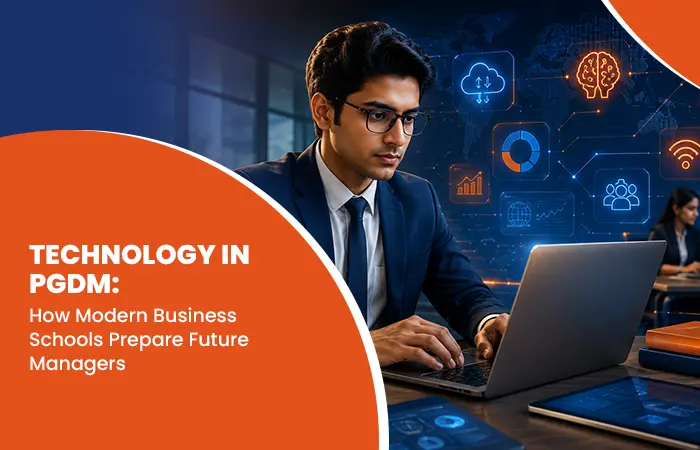
Technology is transforming every aspect of modern business, from finance and marketing to operations and human resources. Today’s employers expect management graduates to be comfortable with artificial intelligence (AI), data analytics, cloud platforms, and digital collaboration tools from day one. As a result, modern PGDM programs are evolving beyond traditional classroom learning by integrating technology-driven education, practical business simulations, and industry exposure to prepare students for the future workplace.
Here’s how modern business schools prepare future managers through technology-driven PGDM education.
The Shift: Digital Transformation in Education and Management
Digital transformation in education and management has come a long way. In the past, simple transformation was pretty evident in both sectors, but now corporate firms are looking for ways to transform their day-to-day operations with the help of AI and Technology. In 2026, digital transformation is the need of the hour for the education and management sector to help employees become more productive and daily operations become smoother.
Top tier Institute does not only provide a basic theory overview of technology and digital transformation in different phases, but they also embed digital workflows into the learning experience. By working through this curriculum, you not only study digital transformation but you get to practice it.
Navigating the Tech-Driven Core: Technology in the PGDM Course
Technology is no longer an optional component of management education. Modern PGDM programs integrate AI, business analytics, cloud computing, enterprise software, and digital collaboration tools into the curriculum so students develop practical skills alongside management concepts. This approach prepares graduates to make data-driven decisions and adapt quickly to evolving business environments.
The integration of technology into the PGDM curriculum occurs at multiple structural levels:
Beyond Textbooks: The Power of Digital Learning Platforms
The modern classroom is not only about physical textbooks but about advanced digital learning through cloud-based Learning Management Systems (LMS) that serve as collaborative corporate environments.
Group projects are executed using agile project management tools like Asana, Jira, or Trello. This approach is just like the operational realities of remote and hybrid corporate teams, training students in digital collaboration, virtual cross-functional leadership, and asynchronous workflow management.
Case Studies in the Cloud: Virtual Business Simulations
Shifting from traditional case studies, which are essential for sharpening analytical thinking, institutes are moving towards cloud-based business simulations. The simulations are like games in which you are a manager or executive in a hypothetical multimillion-dollar company, and you have to make real-time decisions about operations such as production capacity, marketing spend, supply chain logistics, and R&D funding.
The program instantly shows the result of the decisions that the student has taken, helping them to learn from their mistakes. This provides a safe environment for students to practice real-world examples without losing money or being confined to the traditional method of learning.
How Technology is Transforming PGDM Education?
Technology has fundamentally changed the way management students learn and apply business concepts. Instead of relying solely on classroom lectures, business schools now combine digital learning platforms with practical business applications to create an industry-ready learning experience.
Students today benefit from:
- AI-powered learning platforms
- Cloud-based Learning Management Systems (LMS)
- Virtual business simulations
- Online collaboration tools
- Digital assessments
- Industry-led workshops
- Interactive case studies
This technology-driven approach helps students build problem-solving, collaboration, and decision-making skills that employers increasingly value.
The Modern Executive Toolset: AI, Analytics, and Business Technology
To get a high-pay salary and good placement, students need to be updated with the latest technology like AI. The modern managerial toolkit is built upon three pillars: AI, analytics, and business technology.
When these domains are integrated into a business curriculum, they deliver crucial industry-ready skills:
- Data-Driven Decision Making: Instead of making random guesses, through data-driven decision-making techniques, you learn to analyse data, and through that analysis, you get to dissect massive datasets, discover market trends, optimize pricing models, and predict consumer churn.
- Data Visualization and Storytelling: Mountains of raw data are confusing for someone who is not an analyst. Modern PGDM courses emphasize data storytelling using advanced platforms like Tableau and Power BI, ensuring graduates can translate complex metrics into clear, actionable executive insights.
- AI and Automation Strategy: You learn to integrate AI into the different operations of a corporate firm, from using generative AI for marketing and content generation to Robotic Process Automation (RPA) for HR and accounting. In the end, you learn how to use AI judiciously without compromising confidential data.
- Enterprise Resource Platforms: Exposure to industry-standard platforms like SAP, Salesforce, and HubSpot ensures that graduates enter the workforce with immediate operational literacy, minimizing onboarding time for their employers.
Why Location Matters: Choosing a Top B-School in Hyderabad
Choosing a B-school in Hyderabad gives you a massive advantage because of the technological ecosystem of the city. You get to learn the real workings of joint corporate firms in the city, with a top-tier institute that provides you hands-on training by giving you access to guest lectures and industry visits as a part of the curriculum.
Hyderabad has firmly established itself as one of Asia’s premier technology and corporate hubs. The city’s bustling business districts, including HITEC City, Gachibowli, and the Financial District, house global headquarters and massive R&D facilities for tech giants such as Microsoft, Google, Amazon, Meta, and Apple.
Enrolling in a top-tier PGDM institute in Hyderabad unlocks advantages that may not be available in other cities of the country.
- Experiential Learning & Live Projects: Instead of just learning about big corporate firms on paper, students in Hyderabad work directly with local tech enterprises to solve real-world problems because of the booming tech ecosystem in the city.
- Elite Corporate Mentorship: Top-tier executives, data scientists, and product managers from surrounding tech parks regularly visit campuses as guest lecturers and adjunct faculty. With exposure to real-world examples, students can bridge the gap between theory and practicality.
- Robust Placement Ecosystem: Being embedded in a city that serves as a core engine of the digital economy gives PGDM graduates a distinct advantage. Local corporate recruitment teams maintain close relationships with regional institutions, translating into premium internship opportunities and high-value final placements.
Bridging the Gap: Cultivating Industry-Ready Skills for the Future
A good PGDM program produces leaders who are equipped with the latest technology and have what it takes to get a future-proof job. With the help of digital learning, Data Analytics, and exposure to the regional corporate ecosystem, you become ready to tackle the ever-changing tech and management space because of AI.
As automation continues to reshape entry-level and mid-level corporate roles, the skills that remain irreplaceable are human-centric capabilities infused with technology. Modern business schools focus on building this perfect balance:
Mixing Data with Human Skills
An efficient manager is someone who knows how to read data and analyse it to predict future trends but also knows how to integrate AI into the manual process to make it seamless and faster. A good PGDM program not only makes you future-ready, but it also teaches you how to communicate well, solve team arguments, and motivate employees.
Agility and Continuous Learning
Technology is ever-changing, but a good business school will teach you how to adapt to those changes and continue learning more and more about the tech space. By building a mindset that welcomes change, schools ensure their graduates can adapt to whatever new technology comes out in the future.
The Smart Choice for Tomorrow’s Leaders
Technology has swamped the business world; it is no longer a different vertical, but it is embedded into business operations. Choosing a PGDM program that prioritizes digital transformation, data analytics, and real-world business technology is the single most impactful decision an aspiring manager can make.
By choosing a program that combines a modern, tech-focused curriculum with the business network of a major tech city like Hyderabad. As businesses continue embracing digital transformation, employers increasingly seek management graduates who can combine business strategy with technology. Choosing a technology-driven PGDM program equips students with practical skills, industry exposure, and digital capabilities needed to succeed in the evolving corporate world.
Frequently Asked Questions (FAQs)
1. What is the role of technology in modern business management?
Technology helps managers automate tasks, analyze data, improve decision-making, and increase business efficiency using AI, analytics, and digital tools.
2. Is PGDM equal to a Master’s degree?
Yes. A PGDM from an AICTE-approved autonomous institute is generally considered equivalent to an MBA for employment opportunities.
3. What is the scope of a PG Diploma in Business Management?
A PG Diploma in Business Management offers career opportunities in marketing, finance, HR, operations, business analytics, consulting, and entrepreneurship across various industries.
4. Is PGDM better than MBA?
PGDM is often preferred for its industry-oriented curriculum and practical learning, while an MBA follows a university curriculum. The better option depends on your career goals and the institute you choose.