Last date to Submit Full Paper: October 16, 2026
In-Principle Decision:
Within 5 working days of receiving the full paperFirst Blind Review Feedback:
Within 15 days of the in-principle decision
Second Open Review Feedback:
During paper presentation at the conference
One Week Free Online Research Accelerator Program for Faculty :
Ethical AI in Research Writing (Online Mode) — October 5–9, 2026, 8:00 PM to 9:00 PM
Conference Venue: Institute of Public Enterprise, Shamirpet Campus, Hyderabad
Registration Opens on: September 14, 2026
Last Date for Registration: November 5, 2026
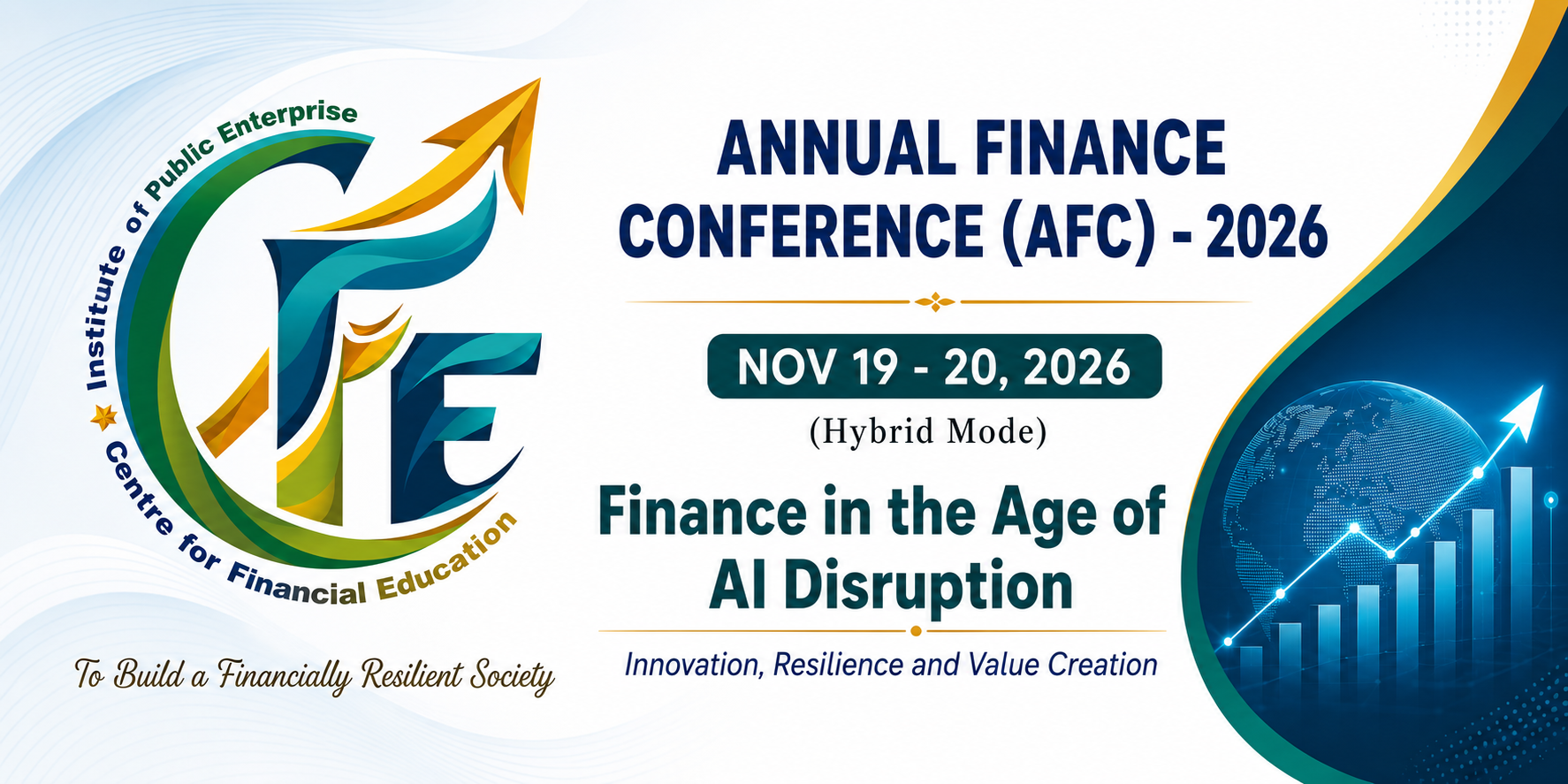
The IPE Annual Finance Conference 2026, organized by the Centre for Financial Education (CFE) at the Institute of Public Enterprise (IPE), provides a platform for academicians, research scholars, practitioners and policymakers to exchange ideas, present research and engage in meaningful discussions on contemporary developments in Finance.
Artificial Intelligence is rapidly reshaping the financial landscape, influencing how financial institutions operate, markets function, risks are assessed and decisions are made. Alongside the opportunities created by AI and digital innovation, the financial world is also navigating emerging risks, regulatory concerns, geopolitical uncertainties and growing expectations for sustainable and responsible growth. Against this backdrop, the conference is themed “Finance in the Age of AI Disruption: Innovation, Resilience and Value Creation.”
The conference invites high-quality research across diverse areas of Finance and allied disciplines, with a focus on understanding emerging opportunities and challenges, strengthening financial resilience and creating sustainable value. Through academic and practitioner perspectives, AFC 2026 seeks to foster insightful dialogue, encourage interdisciplinary research and generate relevant insights for academicians, businesses, financial institutions, investors and policymakers.
We welcome papers from the following sub themes / areas:
This theme explores the transformative role of artificial intelligence and advanced analytics in financial analysis, forecasting, and decision-making. We invite papers on generative AI in finance, machine learning, predictive analytics, algorithmic trading, robo-advisory, AI-enabled valuation and forecasting, intelligent financial models, and emerging applications of AI in financial decision-making.
This theme explores how financial technologies and digital business models are reshaping the delivery and accessibility of financial services. We invite papers on FinTech platforms, digital and neo-banking, blockchain and distributed ledger technologies, cryptocurrencies and digital assets, CBDCs, peer-to-peer lending, digital payments, embedded finance, open banking, and emerging financial technologies.
This theme examines the governance, ethical, security, and regulatory challenges arising from the increasing digitalisation and use of AI in financial systems. We invite papers on responsible and explainable AI, algorithmic bias, AI ethics, data privacy and governance, cybersecurity, digital financial fraud, model risk, RegTech, SupTech, and evolving regulatory frameworks for AI-enabled finance.
This theme explores the changing structure, performance, and intermediation role of banks and other financial institutions. We invite papers on banking performance and efficiency, credit growth and allocation, asset quality and NPAs, credit risk assessment, bank competition and consolidation, NBFCs, priority-sector lending, financial stability, and structural changes in the banking and financial sector.
This theme explores the dynamics, efficiency, and evolving structure of capital and derivatives markets. We invite papers on stock-market behaviour, market volatility and liquidity, price discovery, market microstructure, futures and options, commodity derivatives, structured products, hedging, speculation and arbitrage, trading mechanisms, and innovations in securities markets.
This theme focuses on investment choices, asset allocation, and the performance of professionally and individually managed portfolios. We invite papers on mutual funds, ETFs, portfolio construction and optimisation, asset allocation, investment strategies, performance evaluation, alternative investments, wealth management, institutional investors, and risk-adjusted investment performance.
This theme examines how psychological, cognitive, and social factors influence financial and investment decisions. We invite papers on behavioural biases, investor sentiment, risk perception, financial heuristics, herding behaviour, overconfidence, loss aversion, retail investor behaviour, social-media influences, financial influencers, and behavioural interventions in financial decision-making.
This theme explores approaches to identifying, assessing, and managing financial and non-financial risks while strengthening the resilience of institutions and businesses. We invite papers on enterprise risk management, market and liquidity risk, operational risk, insurance and reinsurance, InsurTech, catastrophe and emerging risks, risk modelling, business continuity, and financial resilience.
This theme examines financial decisions and governance mechanisms that influence firm value and long-term corporate performance. We invite papers on capital structure, cost of capital, dividend and payout policy, mergers and acquisitions, corporate valuation, ownership structures, board effectiveness, agency issues, corporate governance practices, and their implications for firm value and shareholder wealth.
This theme explores the role of finance in supporting sustainable development and responding to environmental and climate-related challenges. We invite papers on ESG investing, green and transition finance, climate finance, green bonds, carbon markets, sustainable investment, climate-related financial risks, impact investing, responsible investment, and financing the transition towards low-carbon economies.
This theme examines developments in accounting, disclosure, reporting, and assurance and their implications for the quality and credibility of financial information. We invite papers on financial reporting quality, accounting standards, earnings management, corporate disclosures, sustainability reporting and BRSR, integrated reporting, auditing and assurance, forensic accounting, and emerging developments in accounting practice.
This theme explores how access, usage, knowledge, and consumer behaviour shape participation in formal financial systems and individual financial well-being. We invite papers on financial inclusion, financial literacy and capability, digital financial inclusion, household finance, consumer credit, micro finance, financial well-being, gender and finance, rural finance, access-to-usage gaps, and consumer protection in financial services.
This theme explores financing decisions and financial challenges across entrepreneurial ventures, start-ups, MSMEs, and family-owned businesses. We invite papers on venture capital, private equity, angel investment, start-up valuation and financing, crowdfunding, MSME finance, entrepreneurial funding constraints, family-business finance, succession planning, ownership transitions, and financing innovation and growth.
This theme examines financial decisions and market developments in an increasingly interconnected and geopolitically uncertain global environment. We invite papers on international capital flows, foreign exchange markets, exchange-rate risk, cross-border investment, international financial integration, global financial crises, geopolitical risk, trade and financial linkages, sovereign risk, and emerging-market finance.
This theme explores the financial implications of customer- and market-related strategies and the contribution of marketing assets to business value. We invite papers on customer lifetime value, customer profitability, brand valuation and brand equity, marketing expenditure and firm value, pricing and profitability, customer analytics, marketing return on investment, customer retention, and the financial impact of market-based assets.
This theme examines how human-capital decisions and workforce practices influence organisational costs, productivity, and financial outcomes. We invite papers on human-capital investment, HR analytics, employee productivity, compensation and financial performance, executive compensation, workforce costs, human-capital disclosure, employee retention and turnover costs, diversity and firm performance, and the financial value of human capital.
This theme explores how strategic and operational decisions translate into financial efficiency, competitiveness, and enterprise value. We invite papers on operational efficiency and profitability, cost optimisation, working-capital efficiency, supply-chain finance, capacity and capital investment decisions, productivity, strategic resource allocation, business-model transformation, operational performance metrics, and the financial outcomes of strategic decisions.
This theme examines the interaction between macroeconomic conditions, public policy, and the functioning and performance of financial markets. We invite papers on monetary and fiscal policy, inflation and interest rates, economic growth and financial markets, public debt, central banking, macro-financial linkages, policy uncertainty, economic shocks, fiscal sustainability, and the transmission of economic policy to financial markets.

| Conference Chairman |
|---|
| Prof. (Dr.) S. Sreenivasa Murthy, Director IPE |
| Conference Convenors | |
|---|---|
| 1 | Prof. (Dr.) Y. Rama Krishna |
| 2 | Dr. Swati Mathur |
| 3 | Dr. P. Kalyani |
| Conference Core Committee | |
|---|---|
| 1 | Prof. (Dr.) V. Srikanth |
| 2 | Prof. (Dr.) Ch. Lakshmi Kumari |
| 3 | Prof. (Dr.) R. Venkateshwara Rao |
| 4 | Prof. (Dr.) A. Pawan Kumar |
| 5 | Dr. K. V. Ramesh |
| 6 | Dr. M. Chandra Shekar |
| 7 | Dr. J. Kiranmai |
| 8 | Dr. Usha Nori |
| 9 | Dr. Swetha Mehrotra |
| 10 | Dr. Hari Shankar Vidyarthi |
| 11 | Dr. Samarendra Kumar Mohanty |
| 12 | Dr. K. Bhavana Raj |
| 13 | Dr. Mousumi Singha Mahapatra |
| 14 | Dr. M. Maschendar Goud |
| 15 | Dr. K. Shree Jyothi |
| 16 | Dr. M. A. Nayeem |
| Conference Advisory Committee | |
|---|---|
| 1 |
Prof. (Dr.) N. Ravi Chandran, Retired Professor – IIM Ahmedabad |
| 2 | Prof. (Dr.) M. Jayadev, Professor, Finance & Accounting; Dean-Administration; Chairperson, CCMRM – IIM Bangalore |
| 3 | Prof. (Dr.) Sankarshan Basu, Professor, Finance & Accounting – IIM Bangalore |
| 4 | Prof. (Dr.) M. Tenmozhi, Professor, Department of Management Studies – IIT Madras |
| 5 | Prof. (Dr.) Rudra Pradhan, Professor & Dean, VGSoM – IIT Kharagpur |
| 6 | Prof. (Dr.) Naliniprava Tripathi, Professor & Dean (Alumni and External Relations), Finance & Control – IIM Shillong |
| 7 | Prof. (Dr.) Deepak. Tandon, Ex-Professor, Finance & Accounting – IMI New Delhi |
| 8 | Prof. (Dr.) Harivansh Chaturvedi, Director General & Professor, Leadership/Marketing – IILM New Delhi |
| 9 | Prof. (Dr.) L. V. Ramana, Professor, Finance & Accounting – IIM Indore |
| 10 | Prof. (Dr.) R. Nandagopal, Director General – STC Coimbatore |
Who Can Submit?
Original research papers on the conference themes are invited from:
Word Limit
Formatting Guidelines
Times New Roman, 12 pt, 1.5 line spacing
Last date to Submit Full Paper: October 16, 2026
Publication Opportunity
Papers presented at the conference will be considered for publication in any of the following after revising the manuscript based on open reviewers’ comments and the respective journal/edited book author guidelines.
Special Issues of the following peer-reviewed and indexed journals:
Edited Books with ISBN Number
Paper Review and Acceptance Process
The papers submitted to AFC 2026 will undergo a multi-stage review process to ensure the quality, originality and relevance of contributions selected for presentation and consideration for publication.
Upon submission of the full paper, an initial assessment will be conducted to evaluate its originality, relevance and research quality. Papers will be checked for plagiarism using Turnitin, with an acceptable similarity limit of 20%. Authors will be notified of the in-principle decision within 5 working days of receipt of the full paper.
Papers accepted in principle will undergo a blind review by subject experts. Reviewer comments and suggestions will be communicated to the authors within 15 days of the in-principle decision, providing an opportunity to strengthen the paper before presentation.
During the conference, papers will undergo an open review through presentation and discussion. Authors will receive feedback and suggestions from experts and participants, enabling further refinement of their research.
Post-conference, authors will be required to revise their manuscripts in light of the feedback received and adhere to the author guidelines of the identified journal or edited volume. Revised manuscripts will undergo further review before being considered for publication.
Responsible Use of AI
Ethical and responsible use of generative AI and AI-assisted tools is permitted. Authors using such tools must clearly disclose the name of the AI tool and the purpose for which it was used in the manuscript. Where AI forms part of the research methodology or data analysis, its use should be appropriately explained in the methodology. Authors remain fully responsible for the originality, accuracy, integrity and appropriate referencing of their work, and AI tools cannot be given credit as authors.
How to Submit?
Send paper submissions in pdf format through Google form
One Week Free Online Research Accelerator Program for Faculty on Ethical AI in Research Writing – October 5 – 9, 2026
In our commitment to support academic excellence and impactful research, we are delighted to host a One Week Pre-Conference Research Accelerator Program for Faculty titled “Ethical AI in Research Writing” during October 5-9, 2026.
This intensive free online one-week program is designed to guide participants in developing high-quality research papers.
All the participants in this program will get a One Week FDP participation certificate. Registrations for FDP will be accepted from September 21, 2026.
Led by eminent faculty, the workshop provides deep insights, practical tools, and personalized feedback to elevate your research journey. Registration to the pre-conference program is free and the detailed schedule of the program will be made available to the participants once they register for the same.
Important Dates:
| Conference Dates | November 19–20, 2026 |
| Last date to Submit Full Paper | October 16, 2026 |
| In-Principal Decision | Within 5 working days of receiving the full paper |
| First Blind Review Feedback | Within 15 days of the in-principal decision |
| Second Open Review Feedback | During Paper Presentation at the Conference |
| Conference Registration Opens on: | September 14, 2026 |
| Last Date for Conference Registration: | November 5, 2026 |
Early submission of papers is highly appreciated to facilitate timely feedback and revisions.
One-Week Research Accelerator Program for Faculty: October 5-9, 2026.
Delegates Registration Fees:
| Faculty Members | ₹3,000/- |
| Research Scholars & Students | ₹2,000/- |
| Practitioners | ₹4,000/- |
| Foreigner Authors | USD 50 |
All the authors of the paper must register individually and at least one of the authors need to present the paper in either offline or online mode, as per their preference.
No additional charges for Publication in Journals or edited books if paper is presented and accepted for publication.
Payment Methods:
The payment can be made online in favour of “Institute of Public Enterprise”, payable at Hyderabad OR Online.
| Account Name | Institute of Public Enterprise |
| Account No. | 52198267621; |
| Bank Name | State Bank of India |
| MICR Code | 500002342; |
| IFSC Code | SBIN0020071; |
| PAN No | AAATI1377G; |
| GST No | 36 AAATI1377G2ZP |
Contact Information:
For any queries feel free to contact the following.
| Dr P Kalyani | Email ID: kalyani@ipeindia.org; Mobile: 98854 63506 |
| Dr Swati Mathur | Email ID: swatimathur@ipeindia.org; Mobile: 98480 39910 |
| Prof (Dr) Y Rama Krishna | Email ID: yramakrishna@ipeindia.org; Mobile: 77024 65393 |
| Prof (Dr) S Sreenivasa Murthy, Director, IPE | |
The Institute of Public Enterprise (IPE) was established in the year 1964 as an Autonomous non-profit society. IPE’s key objectives include training, research, consulting, and management education. IPE has a very successful track record of running training programs for state and central government organizations, public sector enterprises and corporates over a long period of time. IPE also has a strong Research and Consultancy division, which provides consulting services and undertakes research projects for various state and national level organizations and governments. IPE is a premier AICTE approved business school that offers two- year full time PGDM (equivalent to MBA) program focusing on transforming students into leaders of tomorrow. IPE offers six PGDM Programs such as PGDM (Flagship Program), PGDM -MM, PGDM-BFS, PGDM-IB, PGDM-HRM, PGDM-BA with an approved intake of 540 seats. IPE also offers Fellow Program in Management (FPM), a Doctoral program approved by AICTE. The IPE has been recognized as a ‘Centre of Excellence’ by the Indian Council of Social Science Research (ICSSR), Ministry of Education (MoE), and Government of India (GoI). Over the years IPE has won several awards and honours for its academic & research excellence. The Unique Strength of IPE is its Board, comprising of veteran administrators, brilliant scientists, and financial wizards. Shri K. Madhava Rao, IAS (Retd), former Chief Secretary, Govt of Andhra Pradesh is the President of the Institute. Professor. S. Sreenivasa Murthy, a well-known academician, is the Director of the Institute.