


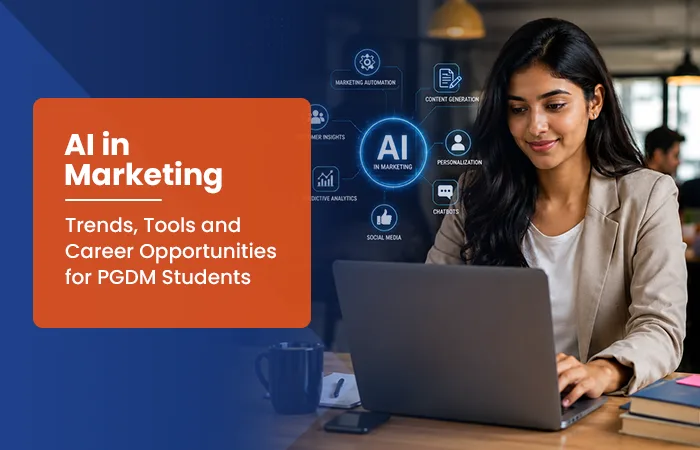
Direct answer: AI in marketing has moved from experiment to default — 68.6% of organizations now use generative AI tools as part of their marketing stack, and 56% of marketers run AI in live production campaigns, not pilots. For a PGDM student, this isn’t a reason to fear the field; it’s a reason to enter it with the right skills. Roles like AI Marketing Specialist, Growth Marketer, and Marketing Automation Specialist are seeing the strongest demand growth through 2030, and institutes like IPE Hyderabad are already building AI and analytics into their PGDM Marketing curriculum to prepare students for exactly this shift.
What “AI in Marketing” Actually Covers
AI in marketing spans three practical layers: content generation (AI writing and image tools), campaign automation (marketing automation platforms that run workflows without manual triggers), and decision intelligence (predictive models that guide targeting and budget allocation). A PGDM student doesn’t need to build these systems but increasingly needs to know how to brief, evaluate, and act on them.
The Adoption Numbers That Matter
| Metric | Figure |
| Organizations using generative AI in marketing | 68.6% |
| Marketers running AI in live production (not just pilots) | 56% |
| Marketers who say AI increased their productivity | 83% |
| Global martech market size (2026) | $669.14 billion, growing to $3.28 trillion by 2035 |
| Marketers naming generative AI the top 2026 trend | 70% |
India-specific detail worth knowing: the AI-adoption gap between metro and tier-2 cities has shrunk from 45% in 2024 to just 23% in 2026 meaning this shift isn’t confined to Bangalore and Mumbai anymore. Hyderabad remains one of the stronger adoption hubs, alongside Bangalore, given its tech ecosystem.
AI Marketing Tools Worth Knowing
| Tool Category | Examples | What It’s Used For |
| Content generation | ChatGPT, Claude, Jasper, Midjourney | Drafting copy, campaign ideas, visual assets |
| Marketing automation / CRM | HubSpot AI, Salesforce Einstein, Mailchimp | Running email sequences, lead scoring, workflows |
| SEO and content optimisation | Surfer SEO, GEO-focused tools | Optimising content for search and AI answer engines |
| Workflow automation | n8n and similar platforms | Connecting tools into automated marketing pipelines |
You don’t need to master all of these fluency with one tool per category covers most entry-level AI in digital marketing careers.
Career Roles Growing Fastest
| Role | What It Involves | Demand Signal |
| AI Marketing Specialist | Running AI-assisted campaigns end-to-end | Among the most commonly posted hybrid marketing roles |
| Marketing Automation Specialist | Building and maintaining CRM/email workflows | One of the fastest-growing specialisations in Indian digital marketing |
| Growth Marketer | Using AI and data to drive measurable revenue impact | Strong demand growth projected through 2030 |
| SEO/GEO Specialist | Optimising for both search engines and AI answer engines | Professionals with cross-functional AI skills command a real premium |
Rather than repeating salary figures across every section, the more useful signal is this: professionals who pair marketing skills with applied AI fluency are seeing meaningfully higher pay premiums than peers without it reported at roughly 20–43% depending on the role and source. The exact number matters less than the direction: AI fluency is becoming a genuine differentiator, not a nice-to-have.
What This Means for a PGDM Student
If you’re comparing a PGDM institute in Hyderabad, this shift changes what a strong Marketing specialisation should teach. IPE Hyderabad’s PGDM in Marketing, for instance, sits alongside its dedicated PGDM in Business Analytics giving students exposure to data-driven campaign thinking rather than treating AI tools as a bolt-on skill. That combination matters more now, since 45% of martech leaders say vendor AI agents still fail to meet promised performance a gap closed by people who understand both the tool and the strategy behind it.
How to Evaluate a B-School’s AI-Marketing Readiness
When comparing a B school in Hyderabad or management institute in Hyderabad, ask specifically:
- Does the marketing curriculum include hands-on work with real MarTech tools, not just theory about them?
- Are live campaigns or case studies updated for 2026’s AI-driven tools, or still built around pre-AI marketing playbooks?
- Does the institute offer cross-training between marketing and analytics electives, given how tightly the two now overlap?
Common Mistakes to Avoid
- Assuming AI removes the need for marketing fundamentals strategy and judgment matter more, not less, when execution is automated
- Learning tools in isolation without understanding the campaign logic behind them
- Ignoring generative AI content tools as “unserious” two-thirds of AI-generated marketing content is expected to be produced outside centralized content teams by end-2026
Conclusion
AI in marketing isn’t a future trend anymore it’s the default operating environment, with 68.6% of organizations already using generative AI tools in their stack. For PGDM students, that makes marketing automation, AI-tool fluency, and data-driven campaign thinking core skills rather than electives. Institutes like IPE Hyderabad, which pair PGDM Marketing with a dedicated Business Analytics specialisation, are positioning students for exactly this shift explore their PGDM programs to see how the curriculum fits your goals.
Frequently Asked Questions
Will AI replace marketing jobs entirely?
No. Adoption data shows AI is reshaping roles toward strategy, prompt-craft, and campaign judgment rather than eliminating marketing jobs. Productivity gains are real, but human oversight of AI output remains essential.
What AI marketing tools should a PGDM student learn first?
Start with one content tool (ChatGPT or Claude), one automation/CRM platform (HubSpot or Salesforce), and basic SEO/GEO fundamentals. That combination covers most entry-level roles.
Is marketing automation a good specialisation to focus on?
Yes — it’s currently one of the fastest-growing specialisations within Indian digital marketing, driven by companies scaling personalised, automated customer journeys.
Does a PGDM in Marketing still matter if AI can generate campaigns?
Yes. AI generates output; it doesn’t set strategy, understand brand context, or judge whether a campaign is actually working. That judgment is exactly what a PGDM is meant to build.
How is India’s AI-marketing adoption different from global trends? India’s metro-to-tier-2 adoption gap has narrowed sharply (45% to 23% in two years), meaning the opportunity isn’t limited to major metro hubs it’s spreading fast across the country.