


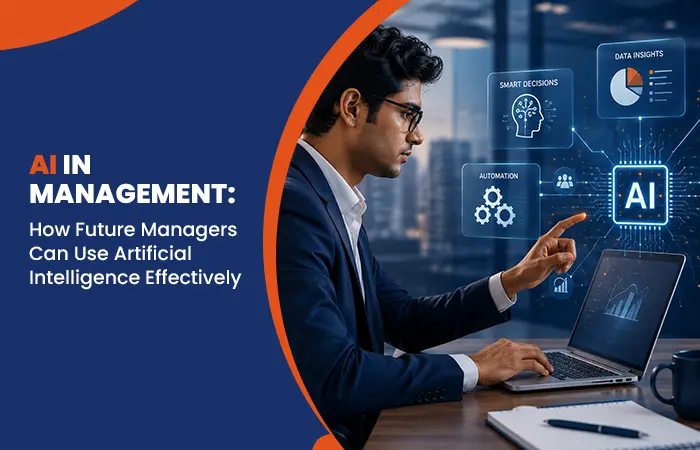
Artificial Intelligence (AI) is transforming the way businesses analyse data, improve productivity, and make strategic decisions. Rather than replacing managers, AI in management acts as a powerful collaborator by automating repetitive tasks, identifying patterns in large datasets, and generating actionable insights. From marketing and finance to human resources and supply chain management, AI enables organisation to work smarter and respond faster to changing business needs. For MBA and PGDM students, learning how to use AI effectively has become an essential management skill that enhances decision-making, improves employability, and prepares them for leadership roles in a technology-driven business environment.
What is AI in Management?
Artificial Intelligence in management refers to the use of AI-powered technologies to analyse business data, automate repetitive tasks, improve operational efficiency, and support strategic decision-making. Modern managers use AI across marketing, finance, human resources, customer service, and supply chain management to make faster and more informed business decisions.
Why AI in Management Matters Today?
Artificial Intelligence has been developed over the years, and its impact has also invaded the IT department. Now you no longer have to manually go through historical data and spend hours on spreadsheets. By integrating AI into your workflow, you can go through your company’s historical data in a fraction of a time and derive outputs from it.
Moving Beyond Automation to Strategic Decision-Making
Artificial Intelligence has moved beyond simple automation and now plays an important role in strategic business decision-making. Modern AI tools help managers forecast market trends, assess business risks, optimise operations, and evaluate multiple business scenarios. Instead of replacing human judgment, AI supports managers by providing data-driven recommendations that improve the quality and speed of decision-making.
The Growing Demand for AI-Savvy Leadership
Companies have mountains of data, but manually going through that data becomes frustrating, and there is a lack of professionals who can understand the data and leverage it strategically. An AI-savvy manager understands how to bridge the gap between technical teams (data scientists and engineers) and executive stakeholders.
How AI is Used in Management Across Key Business Functions
AI defines business functions because now it is not a standalone tool that does tasks simply because you have prompted it to. Now, it can be integrated into the workflow to optimize it and increase the productivity of an employee.
Predictive Analytics in Marketing and Consumer Behavior
AI can predict market trends and create strategies that align with brand image and identity. It analyses billions of consumer data points, from search history and social media sentiment to purchasing patterns, and enables hyper-personalized marketing at scale.
Managers use predictive analytics to map customer journeys, anticipate churn, and optimize pricing strategies in real-time. Instead of launching blanket campaigns, modern marketing managers deploy dynamic, targeted strategies that yield significantly higher returns on investment (ROI).
Optimizing Supply Chains and Operations with Machine Learning
For supply chain logistics, AI monitors every variable, including Global variables such as weather disruptions, shipping bottlenecks, and geopolitical shifts, to predict delays and automatically reroute shipments. If one wants to master operations management, then one should be efficient, which is exactly what AI can deliver; it can detect patterns that might get missed by a human analyst.
Furthermore, predictive maintenance algorithms analyze machinery performance data to schedule repairs before a breakdown occurs, saving corporations millions of dollars in unexpected downtime.
HR and Talent Acquisition: Revolutionizing the Recruitment Pipeline
Human Resource management is heavily utilizing AI to streamline talent acquisition and employee engagement. In high-volume recruitment scenarios, AI-driven applicant tracking systems (ATS) screen thousands of resumes to identify top-tier candidates based on semantic matching and performance predictors. Beyond hiring, sentiment analysis tools gauge employee morale by evaluating internal communication metadata, allowing HR managers to proactively address burnout and retention challenges.
Bridging the Gap: Business Intelligence (BI) and Artificial Intelligence
While the terms are often used interchangeably, understanding the distinction and the intersection between Business Intelligence (BI) and Artificial Intelligence is critical for any aspiring business leader.
| Feature | Business Intelligence (BI) | Artificial Intelligence (AI) |
| Primary Focus | Descriptive and Diagnostic Analysis | Predictive and Prescriptive Analysis |
| Data Scope | Historical and structured internal data | Real-time, historical, structured, and unstructured data |
| Objective | Tells you what happened and why it happened | Tells you what will happen and how to respond |
| Human Input | Requires humans to interpret dashboards and make decisions | Automates recommendations and learns continuously |
From Descriptive Data to Prescriptive Actions
With traditional business intelligence, you can aggregate historical data into a single spreadsheet and visual dashboard, which is good for analysing past trends. However, AI will take this one step ahead and help you drive future predictions and descriptive analytics to take an informed action for the future of the company.
An AI assistant will not only help you understand why sales dropped in the past, but it will also tell you whether or not you will be able to recover the cost in the future or whether sales will drop next month due to a specific emerging trend. It will also give you solutions to make exact inventory adjustments to offset the loss.
Must-Know AI Tools and BI Platforms for Modern Managers
A modern manager must be fluent in a suite of data tools. This includes traditional BI platforms like Power BI and Tableau for data visualization, alongside advanced AI-driven tools. Platforms like Salesforce Einstein infuse CRM workflows with predictive insights, while tools like UiPath drive Robotic Process Automation (RPA).
Additionally, generative AI interfaces and specialized LLMs are increasingly used by managers to draft communications, conduct rapid market research, and synthesize lengthy financial reports.
Core AI Skills for MBA Students and Future Corporate Leaders
Having a degree is no longer enough to get a high-paying job. Recruiters are now looking for people who can integrate AI into their daily operations to help increase productivity and have a futuristic approach to the job.
Data Literacy and Prompt Engineering: The New Management Imperatives
To be a manager, you do not just need to be able to read data, but you need to understand it to some extent. After looking at a set of data, you should have the right questions for it and also recognise statistical anomalies, and translate data findings into actionable business strategies.
Furthermore, prompt engineering has emerged as a vital soft-technical skill. Learning how to effectively instruct and query large language models allows managers to extract highly accurate data analysis, code snippets, and market insights in a fraction of the time it used to take.
Navigating Ethical AI and Algorithmic Bias in Corporate Governance
With great computational power comes significant executive responsibility. AI models are trained on historical data, which means they can inadvertently perpetuate human biases. If a recruitment AI is trained on historical data from a male-dominated corporate era, the algorithm may inherently penalize female applicants.
Modern managers must understand the ethics of AI governance. They must know how to audit algorithmic decisions for bias, safeguard user data privacy, and maintain transparency to ensure compliance with shifting global regulatory standards.
Career Opportunities for Managers with AI Skills
As organisations increasingly adopt Artificial Intelligence, professionals who can combine management expertise with AI-driven decision-making are in high demand. MBA and PGDM graduates with AI skills can explore careers across multiple industries.
| Job Role | How AI Supports the Role |
|---|---|
| Marketing Manager | Uses AI for customer insights, campaign optimisation, and demand forecasting. |
| Business Analyst | Analyses business data to support strategic decision-making. |
| HR Manager | Uses AI for recruitment, employee engagement, and workforce analytics. |
| Operations Manager | Improves efficiency through predictive analytics and process automation. |
| Supply Chain Manager | Uses AI to forecast demand, manage inventory, and optimise logistics. |
| Product Manager | Leverages AI to understand customer behaviour and improve products. |
Curriculum Integration: Preparing Future Managers for an AI-Driven Business World
A modern management education should prepare students for the realities of today’s digital workplace. When choosing a PGDM institute in Hyderabad, look for a curriculum that combines core management subjects with emerging technologies such as Artificial Intelligence, Business Analytics, and Business Intelligence. Practical learning through AI case studies, data visualization, live projects, and industry interactions helps students understand how technology supports better business decision-making across marketing, finance, human resources, and operations.
Why Learn AI-Driven Management at IPE Hyderabad?
At IPE Hyderabad, students gain exposure to AI-enabled management through an industry-oriented curriculum, practical projects, internships, case studies, and regular interactions with corporate professionals. This learning approach helps students understand how AI can be applied to solve real business challenges while developing the analytical, strategic, and leadership skills expected by today’s employers.
Conclusion
Artificial Intelligence is not replacing managers it is transforming the way they work. Organisations increasingly value professionals who can combine management knowledge with AI, data literacy, and strategic thinking to make informed business decisions. By learning how to use AI responsibly and effectively, MBA and PGDM students can improve their employability, enhance productivity, and prepare for leadership roles in an increasingly technology-driven business environment.