


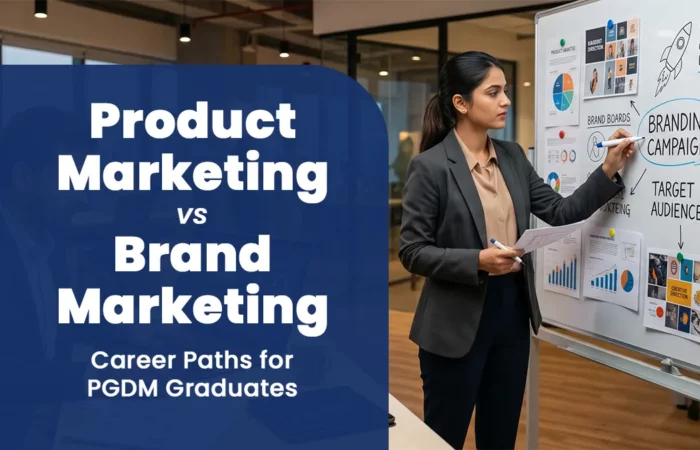
A PGDM in Marketing does not lead to just one kind of job anymore. Walk into any placement season and you will quickly notice marketing has split into tracks that look similar on paper but feel completely different once you are actually doing the work.
Product marketing and brand marketing are the two that trip students up the most. Both fall under marketing. Both need consumer understanding. But what you actually do every day, which industry you end up in, and what kind of thinker thrives in each of these are worlds apart.
If you are trying to figure out which path to go after, here is the honest breakdown.
A Quick Look:
- Product marketing — positioning a specific product, owning its GTM strategy, pushing adoption
- Brand marketing — shaping how people feel about a company over years, not quarters
- Product marketing roles cluster in tech, SaaS, fintech, e-commerce
- Brand marketing roles cluster in FMCG, D2C, consumer goods
- Both eventually take you to strong marketing manager roles and leadership
- Which one suits you comes down to your strengths, your preferred sector, and what your internship already told you about yourself
What Is Product Marketing in a PGDM?
Here is the simplest way to think about it: someone has to figure out why a product deserves space in the market, who actually needs it, and how to say that in a way that makes people stop and pay attention. That is product marketing.
Not advertising. Not content creation. The strategic layer underneath all of it.
Before a product launches, a product marketer is defining the audience, writing the messaging framework, and building the go-to-market plan. During the launch, they are making sure sales teams and campaigns are not saying five different things. After launch, they are watching adoption numbers, reading customer feedback, and reworking the positioning wherever it is not landing.
What separates this from general marketing is the direct revenue pressure. Weak messaging means a weaker pipeline. You see the consequence of your thinking in real numbers, fast. That kind of accountability is exactly what attracts certain people to this track — and exactly what pushes others away from it.
Common entry-level titles in product marketing:
- Product Marketing Associate
- GTM (Go-to-Market) Analyst
- Category Executive
- Growth Marketing Analyst
What Is Brand Marketing in a PGDM?
Brand marketing runs on a completely different clock. The question driving the work is not “who should buy this product” — it is “how do people feel about this company, and where do we want that feeling to go over the next three years?”
A brand marketer builds identity. Emotional connection. Cultural relevance. The kind of trust that makes someone reach for a product on instinct without consciously comparing it to alternatives.
Day to day this means advertising campaigns, consumer research, media planning, agency management, and tracking brand health over time. Every piece of work connects back to the same underlying goal — move perception in the right direction, deliberately and consistently.
The most respected entry point into brand marketing in India is the Assistant Brand Manager role in FMCG. What makes the ABM role unusual for an entry-level position is the ownership it hands you early. Managing agency relationships, contributing to annual brand plans, running consumer research, tracking metrics that feed into real business decisions — this is not assistant work in a passive sense. It is a genuine responsibility from week one.
Common entry-level titles in brand marketing:
- Assistant Brand Manager (ABM)
- Brand Executive
- Marketing Communications Analyst
Product Marketing vs Brand Marketing: Key Differences
| Factor | Product Marketing | Brand Marketing |
|---|---|---|
| Core Question | Who needs this and why should they care? | How do people feel about this company? |
| Primary Goal | Drive product adoption and revenue | Build brand equity and long-term loyalty |
| Time Horizon | Short to medium term | Long term |
| Works Closely With | Product, Sales, Engineering | Creative agencies, PR, Media planners |
| Key Skills | GTM strategy, positioning, competitive analysis | Consumer insight, campaign planning, storytelling |
| Success Measured By | Conversions, pipeline, product adoption rate | Brand recall, NPS, share of voice |
| Best Sector Fit | Tech, SaaS, Fintech, E-commerce | FMCG, D2C, Retail, Consumer Goods |
| Entry-Level Role | Product Marketing Associate, GTM Analyst | Assistant Brand Manager (ABM) |
Career Path: Product Marketing After PGDM
Progression
Product Marketing Associate → Product Marketing Manager → Senior PMM → Director of Product Marketing → VP Marketing → CMO
Early years are mostly about doing — writing positioning, running launches, learning to hold your own in rooms with product managers and sales leads. Gradually the scope gets bigger. One product becomes a product line. A product line becomes a company-wide go-to-market strategy. The thinking gets more complex but the core skill of making the right people care about the right thing stays the same throughout.
Skills That Actually Matter
- Go-to-market planning and execution
- Consumer segmentation and targeting
- Competitive research and positioning
- Messaging frameworks and sales enablement
- Comfort with analytics tools and performance metrics
Traditional Product Marketing vs Modern Product Marketing
| Approach | Traditional | Modern |
|---|---|---|
| Positioning | Feature-led messaging | Outcome-led, consumer-first messaging |
| Launch Strategy | Campaign-only approach | Full GTM with sales alignment |
| Measurement | Impressions and reach | Adoption rate, conversion, pipeline |
| Consumer Understanding | Assumed from briefs | Research-backed and continuously tested |
| Cross-functional Work | Siloed marketing | Integrated with product and sales from day one |
Career Path: Brand Marketing After PGDM
Progression
ABM → Brand Manager → Senior Brand Manager → Marketing Manager → VP Marketing → CMO
Brand marketing in FMCG has a clear ladder and climbing the early rungs is genuinely hard work. The ABM role throws you in. Briefing agencies, reading consumer research, managing budgets, contributing to brand plans that shape how millions of people perceive a product. The people who rise fastest are not just creative — they are rigorous thinkers who happen to also communicate really well.
Skills That Actually Matter
- Consumer behaviour and qualitative research
- Campaign planning and integrated media strategy
- Agency briefing, evaluation, and management
- Brand health tracking — awareness, consideration, NPS, share of voice
- Long-term strategic thinking about brand positioning
Traditional Brand Marketing vs Modern Brand Marketing
| Approach | Traditional | Modern |
|---|---|---|
| Campaign Planning | TV and print-led | Integrated across digital, OOH, and social |
| Consumer Research | Annual studies | Ongoing insight generation |
| Brand Measurement | Recall surveys | Multi-metric brand health tracking |
| Agency Relationships | Execution-focused | Strategic partnership |
| Decision-Making | Experience-led | Evidence-backed with data support |
Which Career Path Is Right for PGDM Graduates?
No framework will give you a clean answer here. But the two tracks do pull different kinds of people and most students already have a leaning, they just have not put a name to it yet.
Product marketing probably fits you if:
- Data and measurable outcomes feel natural, not tedious
- You want your work to connect directly to revenue
- Fast-moving, cross-functional environments energise you
- Tech companies and startups genuinely excite you
Brand marketing probably fits you if:
- You naturally think in stories and consumer emotions
- You find yourself curious about why certain brands earn loyalty while others do not
- A structured, corporate growth path appeals to you
- FMCG or large consumer goods companies are where you want to build your career
One honest signal most students ignore — look back at your summer internship and ask which tasks did not feel like effort. Not which ones looked good. Which ones pulled you in without trying. That answer is almost always right.
How a PGDM in Marketing Prepares You for Both Tracks?
A strong PGDM Marketing Programme does not artificially split these tracks it builds skills that travel across both:
- Consumer Behaviour — the foundation of audience understanding in both product and brand marketing
- Marketing Research — used for positioning in product marketing, perception tracking in brand marketing
- Integrated Marketing Communications — directly applicable to brand campaign planning
- Business Strategy — essential for GTM planning in product marketing roles
- Live Projects and Internships — the single biggest differentiator when it comes to PGDM marketing jobs at placements
Students who use electives and internships deliberately — as real experiments, not requirements to complete — walk into placement season with a clarity that shows. It is noticeable, and it makes a difference.
Conclusion
Marketing as a career has become specific. Just picking a specialisation is not enough — students who figure out early whether product marketing or brand marketing actually suits them make sharper choices about electives, internships, and the roles they chase during placements.
Both tracks are strong. Both go somewhere worth going. The question was never which one is better in general, it is which one matches how you think, the kind of company you want to grow inside, and the problems you genuinely find worth solving.
For students enrolled in or seriously considering PGDM colleges in Hyderabad, building that clarity before placements begin not after the first offer lands is one of the better investments you can make in your own career.
FAQs
Q: What are the job roles after PGDM in marketing?
After a PGDM in marketing, graduates move into roles like Assistant Brand Manager, Product Marketing Associate, Category Executive, GTM Analyst, Brand Executive, Marketing Communications Analyst, and Digital Marketing Manager. Which role you land depends largely on whether you go down the brand marketing path — more common in FMCG — or the product marketing path, which dominates in tech and e-commerce.
Q: Is brand marketing the same as product marketing?
No. Brand marketing builds the overall identity, perception, and emotional value of a company across everything it sells. Product marketing positions and launches one specific product to a defined audience. One works on a long-term timeline. The other is tied to launches and revenue targets. Different goals, different skills, different industries.
Q: What is the 3-3-3 rule in marketing?
The 3-3-3 rule means grabbing attention in 3 seconds, delivering your core message in 3 sentences, and giving 3 clear calls to action. It is mainly used in content and digital marketing to cut drop-off and keep short-form communication tight.
Q: Is product marketing the best career path?
Among the fastest-growing marketing careers in India right now — especially in tech, SaaS, and fintech. Works well for analytical graduates who want direct proximity to revenue. Whether it is the best path depends entirely on the individual — brand marketing is just as strong for anyone targeting FMCG or consumer goods.
Q: What is the difference between product marketing and brand marketing?
Product marketing owns a specific product — its positioning, messaging, and GTM strategy — to drive adoption and revenue. Brand marketing owns the entire company’s perception — shaping how consumers feel about the brand across every product and touchpoint over the long term.
Q: Which marketing career is better for PGDM graduates in India?
Depends entirely on the person. Data-driven graduates who want fast feedback and business proximity tend to do well in product marketing. Consumer-psychology-driven graduates who want structured corporate careers tend to thrive in brand marketing. Your internship experience will tell you more than any comparison chart.
Q: What are the top PGDM marketing jobs in India?
Assistant Brand Manager in FMCG, Product Marketing Associate in tech and SaaS, Category Executive in e-commerce, GTM Analyst at funded startups, Brand Executive at scaling D2C brands.
Q: What does an Assistant Brand Manager do in FMCG?
Manages brand campaigns end to end — briefing creative and media agencies, tracking brand health metrics, running consumer research, managing budgets, contributing to the annual brand plan. One of the few genuinely ownership-heavy entry-level roles in Indian marketing.
Q: Can a PGDM graduate switch from brand marketing to product marketing?
Yes, and it happens fairly regularly in the first three to five years. Consumer understanding, strategic thinking, and communication skills carry across both tracks. The shift from FMCG to tech usually needs some upskilling in data tools and digital platforms — manageable with intention.
Q: How long does it take to become a marketing manager after PGDM?
Typically six to ten years. In FMCG the path is structured — ABM to Brand Manager to Marketing Manager — follows a defined timeline. In tech and startups it moves faster or slower depending on company growth and how quickly you demonstrate impact.